Choosing the Right Workspace when your employees count is growing

Serviced Offices and Managed Offices
Every growing team eventually asks the same question: should we use a flexible space that grows with us, or move to a traditional office with somewhat excess capacity, but built specifically for our company needs and culture? And is it just a plain trade-off between optimized costs and having your own bespoke office environment or is there another way? The good news is that flexible workspaces have already evolved far beyond a simple alternative to traditional office leases, and today businesses can choose from a range of models designed to support different ways of working, growth ambitions, operational priorities, branding and people strategy and culture. The flex office solutions for corporate clients now work around two main pillars Serviced Offices and Managed Offices.
Serviced Office is a fully furnished, ready-to-use workspace, it includes a private office space plus usage of common meeting rooms and amenities, professionally run by an operator, where a business pays for space and services without taking on any operational responsibility. On the other hand, Managed Office is a fully customized workspace, designed and built for one company – where day-to-day running is still outsourced to an external partner, but the design, branding and layout are built entirely for the specific tenant. Though the two terms are often used interchangeably, they answer different questions: one is about how much flexibility a growing team needs, the other is about turning a space for the mid to long term strategy of an established corporate team.
The choice isn’t about which model is better – it’s about which one fits your business situation, your people and the way you plan to grow. Understanding both is the first step toward finding the office solution that supports your business today and its growth tomorrow.
Serviced Office: Flexibility Without Operational Complexity
A Serviced Office is best understood as workspace-as-a-service: the workplace is fully operational from day one, giving businesses the flexibility to get started without the time and complexity of setting up an office. That flexibility is what makes it such a natural fit for small to medium teams – a two or five-person team opening its first office in a new city doesn’t need a design brief, it needs a space that can flex with it, so everyone’s attention can stay on the business.
That simplicity comes from a space that’s fully equipped and already staffed: furniture, internet, availability of different meeting rooms, relax areas, kitchen amenities, reception and maintenance are all handled by the provider, allowing teams to move in almost immediately.
This model suits small to medium teams still testing their growth model, or a company entering a new market, or whose headcount is hard to predict. The private office space itself standardized, so customization and control over design stay limited – a fair trade for what a business gets in return: the flexibility to scale up or down as needed, low upfront cost, predictable monthly pricing and freedom from operational responsibility.
Managed Office: Your Own Office, Settled up and Managed by Experts
A Managed Office gives a larger, well-established company a private space built entirely around its own operations, culture and long-term goals – while someone else still handles the parts that have nothing to do with running the business. Picture a 50-person company with a clear identity and a defined set of needs, which needs a mid to long term stable, branhot home of its own, without adding project or facility management to anyone’s plate.
In practice, that means a fully customized space, designed and built specifically for one company, while an external partner takes care of maintenance, suppliers, infrastructure and admin. Unlike a Serviced Office, the space here is entirely by tenant’s design – but the whole set-up process and the day-to-day running of it is still someone else’s job. The best thing is that having your own big company office doesn’t mean stepping outside the wider coworking community, either: most companies keep access to shared amenities and events, staying as connected to that network as they choose to be.
Companies choose this model when they have relatively large established teams for whom the scale of workspace usage requires own meeting rooms, managers’ rooms and collaborative spaces, and for whom external manifestation of brand identity has become a priority. For many of these companies, the alternative was traditionally a self-managed, ground-up lease: signing directly with a landlord and building out the space themselves, at significant upfront capital cost. Contracts here run longer, since design and fit-out need time to pay off, which means fewer exit options if plans change quickly. In return, a Managed Office increasingly replaces that traditional route, offering a comparable level of control over design and branding without the capital outlay of a direct fit-out or the burden of running the space day to day.
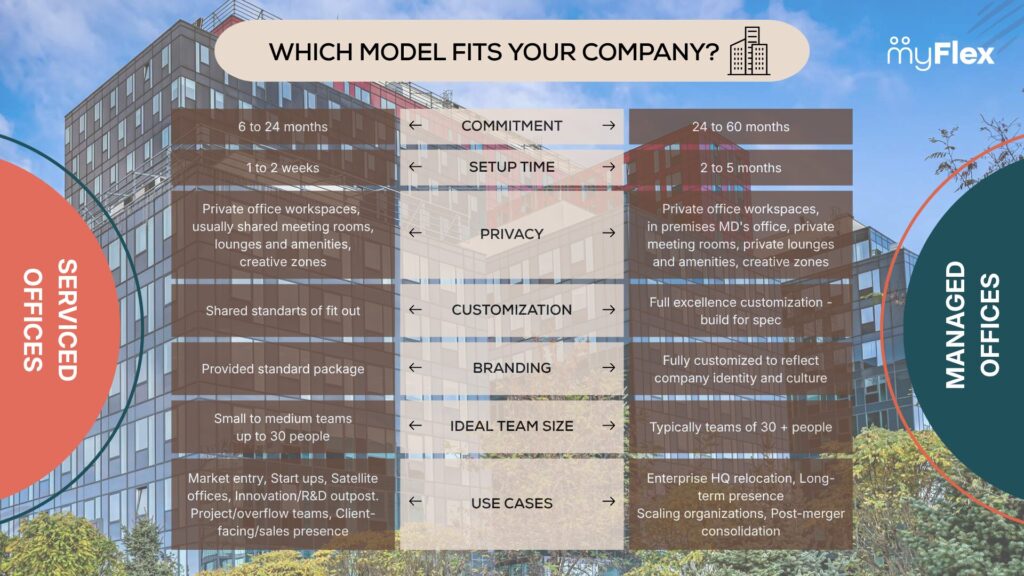
Which Model Fits Your Company?
Serviced Offices and Managed Offices aren’t competing solutions to the same problem – they’re built to solve different problems for different company cases. One prioritizes flexibility and simplicity, suited to small and medium teams that need room to change course quickly – weather this is a startup company or a local office of international corporation. The other prioritizes control, identity and specific functionality, built around the needs of a larger, well-established team.
The right workspace model is the one that fits the way your business operates now – and gives it room to grow into what comes next.